Louisville districts, ZIP codes, and what we find there
Downtown & Riverfront (40202, 40203, 40204, 40206) — Downtown Core, NuLu, Butchertown, Phoenix Hill, Smoketown, Limerick, and Old Louisville: wet stone cellars and Stachybotrys behind finished walls.
Midtown & Central (40204, 40205, 40217) — The Highlands, Germantown, Schnitzelburg, Clifton, Crescent Hill: attic Cladosporium, damp cellars, and knob-and-tube wiring.
East End (40207, 40222, 40223, 40241) — St. Matthews, Lyndon, Anchorage, Prospect, Harrods Creek: dirt crawls, failed vapor barriers, and creek backwater.
Outer East / Corridor (40243, 40245, 40299) — Jeffersontown, Middletown, Douglass Hills, Fisherville: attic condensate and bath fans venting into attics.
South End (40218, 40219, 40228, 40229, 40291) — Okolona, Fern Creek, Highview, Buechel, Camp Taylor: slab moisture and shallow crawls holding water.
Southwest / Dixie Highway (40214, 40216, 40258, 40272) — Pleasure Ridge Park, Valley Station, Shively, Fairdale: repeat flooding, rusted crawl duct, and flood debris.
West End (40208, 40210, 40211, 40212) — Portland, Shawnee, Russell, Park Duvalle: river backwater, vacant-property cleanouts, and code deadlines.
Historic and estate pockets behave differently: Cherokee Triangle and Old Louisville hold dense Victorian mansions with deep stone cellars; Mockingbird Valley, Indian Hills, Anchorage, and Glenview are secluded estates with long drives, big crawls, and uphill wall seepage.
Age, foundation type, and what goes wrong
1870s-1910s Victorian, shotgun, and camelback homes in Old Louisville, Butchertown, and Portland sit on limestone or brick cellars with dirt floors, where Stachybotrys grows on framing and cellar walls.
1900s-1930s Craftsman, Tudor, and Beaux-Arts homes in the Highlands, Cherokee Triangle, and Crescent Hill have brick or block partial cellars, where Cladosporium colonizes unvented attic decking.
1920s estate and hillside builds in Indian Hills, Mockingbird Valley, and Glenview sit on stepped stone or block basements prone to uphill wall seepage.
1950s-1970s ranch and split-level homes in St. Matthews, Lyndon, Okolona, and PRP are slab-on-grade or shallow dirt crawl, leading to slab wicking, crawl vapor drive, and rusted duct.
1980s-2010s colonials in Jeffersontown, Middletown, and Prospect have poured basements or block crawls, where the failures are mechanical: attic condensate, bath fans venting into the attic, and oversized AC that never dehumidifies.
Mold removal and crawl space encapsulation
Louisville sits in the Ohio River valley, and the valley traps humidity. Summer dew points routinely reach the upper 60s and low 70s, and that moisture moves into crawl spaces, cellars, and attics, finds a cold surface, and condenses. Spring rain and a rising river push water into cellars and crawls; summer is the growth season; fall brings the musty smell as condensation moves onto cooling surfaces; winter puts frost and drip on cold roof decks.
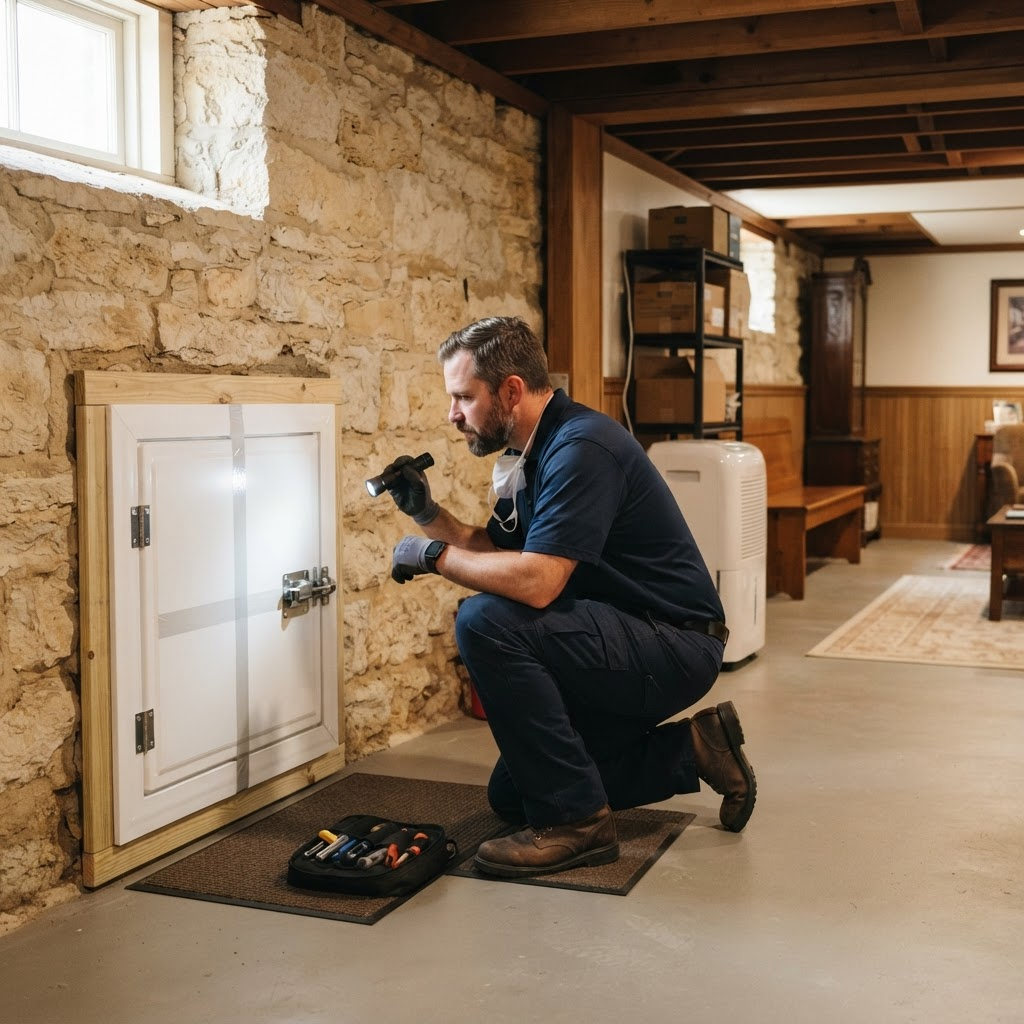
We follow the general approach reflected in the IICRC S520 and S500 standards and EPA guidance: free inspection and written scope, identify and fix the water source, containment with negative air pressure and HEPA filtration, remove non-salvageable porous material, HEPA vacuum and clean structural surfaces, dry to target with dehumidification, and a final verification walkthrough backed by our limited lifetime warranty.
Encapsulation is the fix for the dirt crawl space, the most common moisture source in Jefferson County. It is a sealed system: clear debris and standing water, handle bulk water with grading or a sump, install a heavy reinforced liner up the walls sealed at every seam, seal vents and rim joist gaps, add a crawl dehumidifier, and replace rusted duct and insulation while the space is open. It pays off most in the East End, the South End, and the Southwest, where flood history makes vapor control non-negotiable.
Junk removal in Louisville
Hauling is easy. Getting a truck legally close to the door separates a two-hour job from a six-hour one. Downtown and Riverfront staging usually means an alley or metered street lane with a permit required; Midtown relies on street or rear alley with dense parking; the East End and Outer East give us private driveways and the easiest staging; the South End and Southwest use driveways or curbs, with the Southwest carrying heavy flood debris; the West End often runs through historic alleys, frequently the best route available.
A dumpster or commercial truck occupying a public right of way in Louisville Metro legally requires a Right-of-Way Permit from Louisville Metro Public Works, and a truck left unattended with the engine running is a separate parking violation under Metro Code section 72.032. We handle the permitting so you file nothing and pay no citation.
In Jeffersontown, Middletown, Fisherville, Prospect, and most newer subdivisions, HOA covenants cap how long a dumpster can sit, with fines accruing daily. Our default is same-day load and go: the truck arrives, the crew loads, the truck leaves, and nothing sits overnight for the HOA to cite.
Where removed material goes
Donation: usable furniture, appliances, cabinets, and fixtures go to local nonprofit reuse outlets and building-material donation centers such as Habitat ReStore.
Recycling: metal and appliances go to local scrap processors, with cardboard, clean wood, and yard waste routed accordingly.
Electronics: screens and computers go to certified e-waste handlers.
Hazardous items: paint, solvents, and chemicals route to the appropriate hazardous-waste program.
Landfill: only what is left after every other stream has been checked.
Hoard cleanouts and extreme cleanouts
This is not junk removal with more boxes. It involves a family, often a city deadline, and usually something worth saving in the middle. In Germantown, Schnitzelburg, Portland, Smoketown, and the Old Louisville side streets, houses sit close together, so we work from unmarked vehicles, use the rear alley where one exists, and keep the front of the house ordinary. In Mockingbird Valley, Anchorage, and Glenview, long private drives keep the work out of sight entirely.
Hoarding conditions frequently draw citations from Louisville Metro Codes and Regulations or the Jefferson County health authority, usually over exterior accumulation, pest activity, blocked egress, or unsanitary interior conditions. We scope to the violation language, clear exterior and egress-blocking material first because that is what an inspector re-checks, handle biohazard with proper PPE and disposal routing, and document conditions before and after.
In pre-1940 housing across the West End, Old Louisville, Butchertown, Portland, and the older Highlands blocks, hoard weight is a structural concern: joists sized for 1900s loads, stacked books and canned goods, and knob-and-tube wiring buried in paper are fire and collapse risks we check before crews start work. Documents, photos, and heirlooms go to a sorting station and back to the family; currency, jewelry, firearms, and prescriptions are secured immediately; usable furniture goes to donation partners; metal and electronics go to recycling; contaminated soft goods are handled as biohazard; general debris is loaded last to permitted landfill.
What a job looks like, start to finish
1. Call or book online at 502-387-8161 or through our scheduling link.
2. Free inspection, with moisture readings and an access assessment.
3. Written scope and quote, with no same-day-only pricing games.
4. Scheduling and permits, including any right-of-way permit or HOA notification.
5. Site protection: floor and wall protection on the carry path, containment for mold, privacy for cleanouts.
6. The work, sequenced to keep the rest of the house clean.
7. Moisture-source correction on mold jobs, so the problem does not return.
8. Verification: meters, a visual check, and a walkthrough with you.
9. Disposal routing to donation, recycling, e-waste, hazardous handling, or landfill.
10. Final sign-off and limited lifetime warranty on remediation work.
Cost and timeline expectations
Mold inspection: free, 1-2 hours. Small-area remediation: $500-$1,500, 1 day. Basement or cellar remediation: $1,500-$5,000, 1-3 days. Attic remediation: $1,500-$4,500, 1-2 days. Whole-home remediation: $5,000-$15,000 and up, 3-7 days. Vapor barrier replacement: $1,200-$3,000, 1 day. Crawl space encapsulation: $3,500-$12,000, 2-4 days. Junk removal, partial to full truck: $150-$900, same day. Hoard cleanout, single room: $1,000-$3,000, 1-2 days. Full hoard or extreme cleanout: $4,000-$20,000 and up, 2-7 days.
Historic districts with third-floor walk-ups and no driveway run toward the top of a range, because stairs are labor. Suburban homes with garage access run toward the bottom. Every number is a typical range, not a quote — the free inspection produces your real number.
Why local knowledge changes the outcome
Flood history changes scope: in the Southwest and low West End, a repeatedly flooded basement needs a moisture-control plan, not just cleaning. Foundation type changes the fix: slab-on-grade in Okolona is not a dirt crawl in St. Matthews or a stone cellar in Old Louisville. Attic ventilation is a Midtown problem, since cleaning roof decking without clearing buried soffit vents guarantees a callback. Mechanical failure is an Outer East problem, where the fix lives at the air handler or bath fan, not the drywall. Access changes the price, since we know which blocks have usable alleys and where a truck will not fit. And preservation matters: protecting original plaster, trim, and floors in Cherokee Triangle and Old Louisville is part of the job.
Frequently asked questions
Do you charge for a mold inspection in Louisville? No. Inspections and quotes are free anywhere in Louisville Metro, with moisture readings and a written scope.
My crawl space already has plastic on the ground. Do I still need encapsulation? Usually yes. Thin poly laid loose over dirt is a vapor retarder at best, and in most mid-century crawls it has torn or rotted.
Do I need a permit for a dumpster in front of my house? On a public street, alley, sidewalk, or parking lane, yes — that requires a Right-of-Way Permit from Louisville Metro Public Works. We handle permitting.
Is black mold in my basement dangerous? Stachybotrys grows on repeatedly wetted cellulose and is common in Louisville basements with flood history. It should be removed with containment and the water source fixed; health questions belong with a physician.
Can you work around a code enforcement deadline? Yes. We scope to the violation language, clear exterior and egress conditions first, and document the result.
Will the neighbors know what is happening? Not from us. We use unmarked vehicles, rear alley access where available, and keep the front of the property ordinary-looking.
Get a free inspection in Louisville
If you have a musty smell you cannot place, water in the basement after every hard rain, a crawl space you have been avoiding, or a house full of material that needs to go, we will look at it for free.
Call or text 502-387-8161, or book online. Free quotes, free inspections, a limited lifetime warranty on remediation, and a referral program paying 15 percent up to $500.