5.0 out of 5 on Google
Read our reviewsThe Mold Men Journal
Brief Guide to Mold, and Mold Remediation with EPA Standards
Explore the official EPA mold remediation guide to learn how homeowners can safely clean up mold and prevent future growth in your house.
By Chase Walkup, owner · Published
The Short Version
The EPA's mold guidance is useful because it starts with the part homeowners can act on: control moisture, address affected materials, and avoid making the problem larger during cleanup. It does not start with a frightening species name or a promise that one product can solve every room.
The phrase EPA standards needs care. The agency's household and commercial-building guides provide practical recommendations. They are not a nationwide residential licensing program, a contractor endorsement, or a federal pass-fail spore count.
This guide explains how to use those publications when evaluating a building and comparing a proposal. It covers the difference between small-area advice and a more involved job, the limits of sampling, and what should be established before cleanup is called complete. The point is to turn guidance into useful questions, not to put an official-looking label on a vague estimate.
This guide covers:
- Two guides serve different readers
- Source correction comes before cosmetic improvement
- Material decisions need context
- Small-area advice is not a license for careless work
- Testing has a defined role
- What completion should establish
Two guides serve different readers
The Brief Guide to Mold, Moisture and Your Home is intended for household decisions. The schools and commercial buildings guide addresses a broader planning context.
Their publication history does not make every older recommendation invalid. Read current agency pages, note the context, and distinguish guidance from laws or project-specific requirements.
Source correction comes before cosmetic improvement
Removing growth without addressing wetting leaves the conditions that allowed it. Common sources include leaks, exterior water entry, condensation, and poorly managed exhaust.
Before choosing a treatment:
- Establish what got wet and why.
- Identify affected and concealed layers.
- Decide what can be cleaned or must be removed.
- Plan protection and access.
- Set completion conditions before rebuilding.
Our inspection service helps define those building questions. A stronger fragrance or fresh paint does not demonstrate source correction.
Read the household and commercial guides for their purposes
The household publication helps owners and renters understand common moisture and cleanup questions. The schools and commercial-buildings guide gives more detail about planning, materials, containment, and worker precautions for more involved situations.
They can inform a residential project without making every recommendation an enforceable rule for every house. The actual project also has to follow applicable requirements for worker protection, regulated materials, construction, and other activities.
Ask a contractor which guidance or standard supports the proposed method and how it applies to your condition. Quoting the title of a publication is less useful than explaining why the proposed removal, cleaning, and protection fit the building.
Area is one consideration rather than the entire decision
The familiar small-area guidance is often repeated without the circumstances around it. Even the EPA's remediation table says its size groups are not based on health effects. A limited patch on an accessible hard surface is different from the same visible area attached to extensive concealed wetting, an HVAC concern, or contaminated water.
Material condition and occupant circumstances also matter. If the owner cannot inspect the source safely, or disturbance will open suspect layers, the project may require professional assessment even when the visible patch is small.
Use area to help describe the work, then ask the rest of the questions: what got wet, what remains wet, what is accessible, what other hazards are present, and how the surrounding rooms will be protected.
Cleaning is not the same as killing
The goal is not simply to apply something that affects living organisms. Particles and damaged materials remain physical conditions that need appropriate attention. A treatment claim should not replace a description of removal and cleaning. The EPA's remediation guide says using a biocide such as bleach is not recommended as a routine practice.
Ask how the contractor deals with unsalvageable porous materials and how retained surfaces are cleaned. Ask what happens to contents. A chemical may be one element of a process, but a scope that names only the chemical leaves most of the work unexplained.
Painting over an affected surface is another common shortcut. It may improve appearance while the material and water source remain unresolved. Ask what supports readiness for a finish rather than assuming a stain-blocking coating establishes it.
Use completion guidance before the project begins
Completion is easier to evaluate when the owner and contractor agree on what it means at the start. Source correction, material condition, cleanliness, and the absence of unresolved wetting are more useful than a generic promise that the room will be treated.
Ask what observations and records will support the final review. If outside verification is appropriate, arrange the role and criteria in advance. Not every job needs the same laboratory package, but every job needs a defined outcome.
Then revisit the area under normal conditions. A building should stay improved when the shower is used, the weather changes, or the cooling system operates. Guidance is most useful when it helps the owner see that the cause has been addressed, not merely that the contractor finished the appointment.
Material decisions need context
| Material type | General consideration |
|---|---|
| Accessible hard surfaces | Appropriate cleaning may be practical |
| Porous finishes | Growth within the material can limit cleaning |
| Insulation and paper-faced panels | Condition and access may favor removal |
| Sound framing | Evaluate cleaning and structural condition |
| Flood-soaked contents | Water contamination changes retention decisions |
The EPA material-response table includes clean-water guidance. Do not apply it as though sewage or river flooding were the same event.
Small-area advice is not a license for careless work
The homeowner guide describes circumstances where limited cleanup may be manageable. Size alone does not settle the decision. Contaminated water, hidden damage, occupant vulnerability, and difficult access may require more careful planning.
Do not use a square-foot category as proof that protection is unnecessary. Nor should a company claim that a larger area automatically requires the same full-building method in every case. The proposed precautions should be explained from the conditions.
Testing has a defined role
The EPA sampling page explains that visible growth usually does not require sampling and that federal airborne concentration limits are absent. A laboratory report should answer a particular question rather than serve as a universal safety certificate.
Independent assessment may help with a disputed scope or agreed completion review. Mold Men does not currently provide independent laboratory testing. Define that separate service and its interpretation before purchasing it.
What completion should establish
Ask the contractor how the work will demonstrate:
- The water source has been addressed.
- Retained materials are appropriately dry.
- Visible contamination and cleanup debris have been removed.
- Inaccessible areas and remaining limitations are documented.
- Agreed independent checks, if any, are complete.
Our remediation service explains controlled removal and cleaning. Rebuilding should follow readiness checks, not merely the end of a scheduled equipment rental.
What a useful site visit should leave you with
A visit should make the next decision easier. Before anyone starts, give the person inspecting the property the history in the order it happened. A dishwasher leak followed by a new floor, followed by a smell when the heat comes on, is a different story from a basement that smells only after a week of rain. Dates do not need to be perfect. The sequence does.
Point out what has already been changed. New paint, replacement baseboards, a removed cabinet, and a dehumidifier moved into the room can hide or alter evidence. That is not a reason to leave a leak running. It is a reason to photograph the condition and explain the changes instead of expecting the inspector to reconstruct them from a finished wall.
The walkthrough should connect the affected room with the rest of the building. Water on a basement floor may start at a downspout outside. A stained ceiling may connect to a roof penetration, a bathroom above it, or condensation in an attic. An instrument reading matters more when the person taking it can explain that connection.
Ask for the findings in a form you can use:
- Photographs labeled by room and location.
- The observed water source, or the next investigation needed to establish it.
- Material readings with enough detail to identify where they were taken.
- Areas that could not be inspected and why access was limited.
- A distinction between confirmed damage and a reasonable suspicion.
- The proposed next step, including work assigned to another trade.
A thermal image can help identify a temperature pattern worth investigating. It does not, by itself, identify fungal growth or prove that a surface contains moisture. Likewise, a scanning meter can flag an area for closer examination without giving a complete account of every layer behind it. Good instruments make an investigation better when their limits are understood.
There is also a practical question about access. A hatch blocked by furniture, a crawl space with standing water, or a wall covered by built-in cabinets may prevent a complete assessment. Ask what can be concluded now and what requires another visit or controlled opening. An honest limitation belongs in the report, not in a conversation you cannot later document.
Keep the repair in a sensible order
The source repair and the cleanup may involve different people. A plumber can stop a supply leak without deciding whether wet insulation should remain. A roofing contractor can repair flashing without evaluating the back of the ceiling below it. Make the handoff explicit so each trade knows what has been completed and what remains.
Before new finishes cover the work, confirm that the source correction is complete, retained materials meet the agreed drying criteria, and the cleanup checks have been performed. Keep photographs of the exposed assembly. They are useful if you sell the property, make an insurance claim, or investigate a later leak in the same area.
Finally, put a follow-up on the calendar. Check after the next relevant weather event or period of normal use. A repaired shower should be observed after it is used again. A drainage correction should be reviewed after rain. The purpose is to see whether the building behaves differently, rather than simply whether the new paint looks good.
How controlled cleanup differs from ordinary demolition
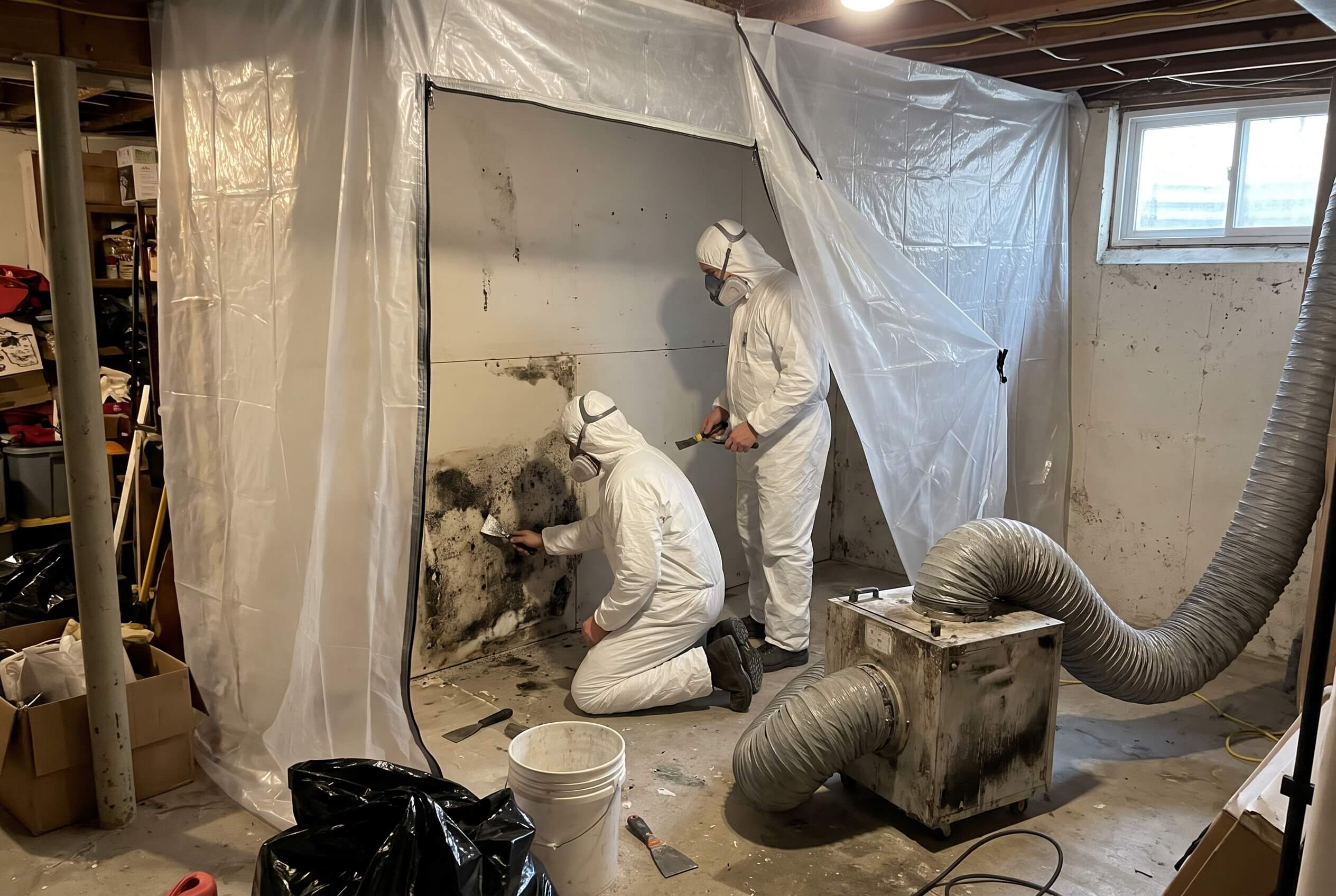
Taking a wet wall out is often necessary. How it comes out matters to the rest of the property. Breaking material apart, dragging it through occupied rooms, and leaving fine debris behind can spread a localized problem beyond the original work area.
Before disturbance, the contractor should define the work boundaries and the protection appropriate to the conditions. The plan may include barriers, controlled access, filtration, and a protected removal route. Equipment and containment should be selected for the project rather than copied from a photograph of another job. Our guide to how HEPA filters capture mold explains what the filter rating means.
Discuss the practical details before the first cut:
- Which rooms can remain occupied and which must be kept clear?
- Where will workers and debris enter and leave?
- What happens to furniture, clothing, and stored items?
- Does the HVAC arrangement require a specific precaution?
- Who handles a discovery that exceeds the original scope?
- What must be checked before protection is removed?
Porous materials that cannot be adequately cleaned may need removal. Accessible retained materials may be cleaned using appropriate methods. The decision depends on contamination, material condition, and access, not simply whether a surface can be made to look lighter with a chemical.
Source correction must also be assigned. Sometimes the cleanup company performs it; sometimes a plumber, roofer, drainage contractor, or other trade does. The owner needs a clear division of responsibility. Otherwise, the removal crew can finish its contract while the underlying wetting remains nobody's task.
Completion should be more than a photograph
A tidy photograph documents appearance. It does not establish the moisture condition of retained materials, the back of an assembly, or the repair of a concealed source. Agree on the completion criteria before work begins so the final review is checking an outcome both parties understand.
Useful records can include labeled progress photographs, the materials removed, cleaning work completed, drying measurements, and source repairs. Where independent verification is appropriate, decide who conducts it and what it evaluates before the project starts. An outside assessment can be valuable without requiring the same sampling package on every job.
Rebuilding should follow that review. Covering a wall too early makes a later question harder to answer and can hide remaining wetting. A construction deadline should not replace the evidence that the assembly is ready.
After normal use resumes, watch the relevant area again. Check the repaired connection, the room that formerly smelled musty, or the foundation after rain. If the condition returns, investigate the water and material history rather than assuming another surface treatment is the entire answer.
This is why remediation, drying, source repair, and reconstruction should be named separately even when one business coordinates them. They work together, but they solve different parts of the problem. The written scope should show how one phase hands the building to the next.
Frequently Asked Questions
Does the EPA certify remediation companies?
These guides do not provide a general EPA certification for a cleanup company. Verify the specific claim and issuing authority.
Is there a federal safe airborne concentration?
No universal federal limit provides a residential pass-fail number for this purpose.
Is every small patch suitable for DIY work?
No. Source contamination, hidden extent, access, and occupant circumstances also matter.
Should I test before repairing an obvious leak?
No. Safe source control should not be delayed just to identify a species.
Can guidance replace project-specific legal requirements?
No. Applicable licensing, hazardous-material rules, and other requirements must be checked separately.
Use the guidance on your own property
If a stain returns, a room smells damp, or water has reached materials behind a finish, arrange an assessment before buying another treatment. We can help turn the moisture history and visible findings into a practical next step.
Book a visit through our online scheduler or call 502-660-2660 to talk through the property. Inspections and quotes are free. Review our Inspection and Mold Remediation pages for more about the relevant services.
Mold Men is based in Louisville and serves the Louisville metro, Owensboro, New Albany, and Jeffersonville. We also handle crawl space encapsulation and vapor barrier replacement when moisture under the floor is part of the problem, along with hoard cleanouts and junk removal when access needs to be restored first.
Every job comes with a written scope before work starts and a written closeout report when it is done. Our referral program pays 15 percent, up to $500, when someone you refer books qualifying work. If you are unsure which service fits, explain the condition when you call and we can discuss the appropriate next step.
Sources
- EPA, A Brief Guide to Mold, Moisture and Your Home
- EPA, Mold Remediation in Schools and Commercial Buildings, Chapter 1
- EPA, Mold Remediation in Schools and Commercial Buildings, Chapter 4 (Table 1: Water Damage Cleanup and Mold Prevention)
- EPA, Mold Testing or Sampling
- EPA, Mold Remediation in Schools and Commercial Buildings, Chapter 5 (Table 2)
- EPA, Mold Remediation in Schools and Commercial Buildings, Chapter 3