
5.0 out of 5 on Google
Read our reviewsThe Mold Men Journal
Extreme House Cleanouts: What to Expect
Prepare for an extreme house cleanout. Learn how to clean a neglected or abandoned house, tackle mold, and when to hire professional services.
By Chase Walkup, owner · Published
The Short Version
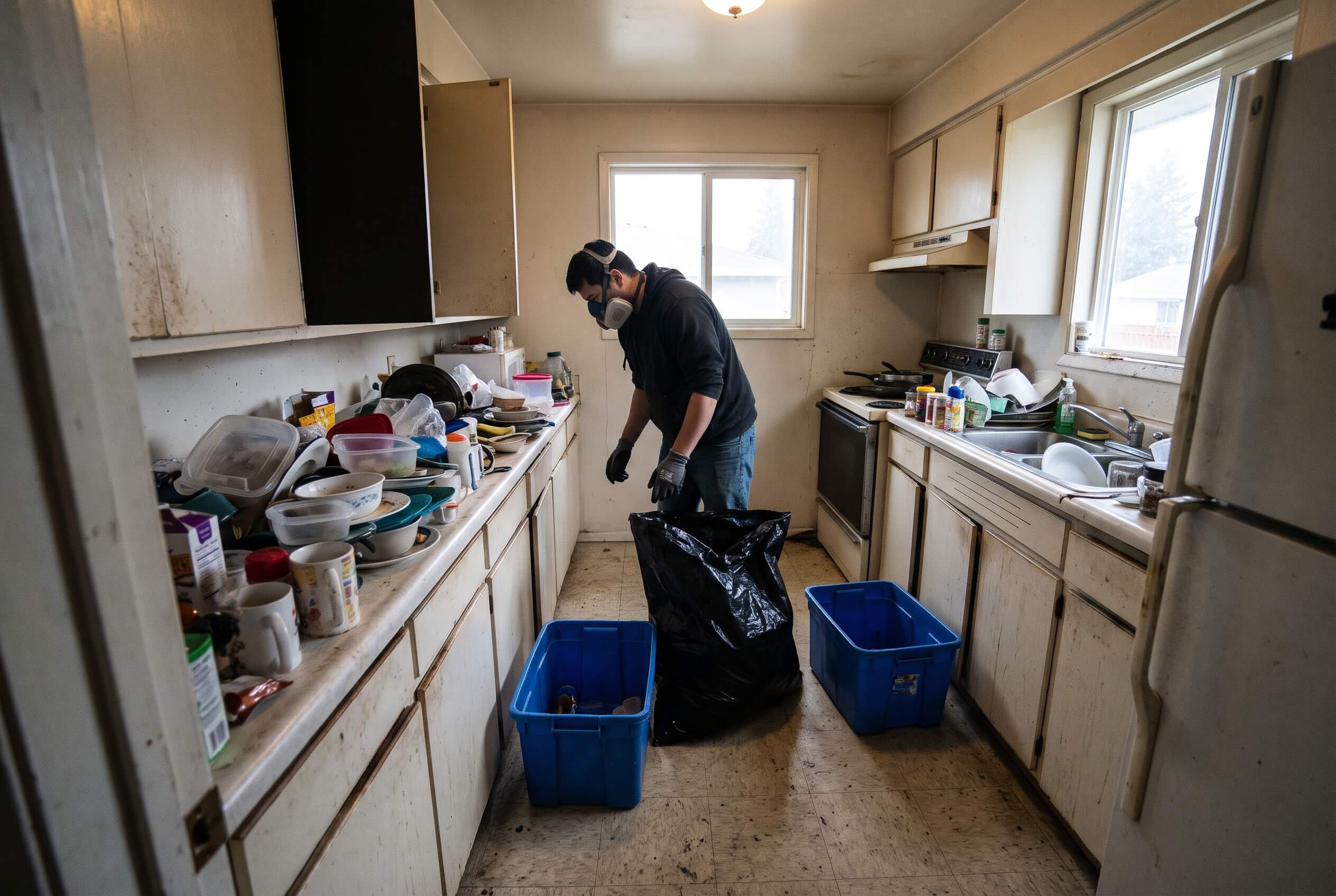
A house left untouched for years can look like a hauling job from the outside and turn into something more involved as soon as the door opens. The contents may need sorting. Utilities may be uncertain. Floors, pests, chemicals, and concealed water damage can change the work before the first truck is loaded.
An extreme cleanout is best approached as a sequence: establish authority and safe access, define what stays, assess the conditions, remove approved contents, and review what becomes visible. That order protects important belongings and keeps a hidden discovery from being treated as ordinary debris.
This guide explains what to expect in Louisville and Southern Indiana, including inherited houses, vacant properties, and heavily accumulated homes. It covers the walkthrough, pricing assumptions, specialist hazards, and the condition the owner should receive at the end. An empty house is useful progress, but it is not automatically a repaired house.
This guide covers:
- Confirm who can authorize the work
- The walkthrough defines the scope
- Expect controlled stages
- Protect essentials before general loading
- Hazards need specific methods
- When access reveals mold
Confirm who can authorize the work
An estate, a former rental, and an abandoned-looking building have different decision issues. A key does not prove that every possession may be discarded.
Confirm the building and contents owner, any representative's authority, protected records, access restrictions, and unresolved occupancy questions. Do not assume tenant possessions are abandoned because a lease ended. Obtain appropriate advice and authorization when needed.
The walkthrough defines the scope
Floor condition, utilities, exits, pests, odors, water history, and suspect materials can affect the plan. Explain inaccessible rooms, animals, chemicals, sharps, or medications before the crew arrives.
A written agreement should separate:
- Ordinary contents removal.
- Sorting and retained possessions.
- Cleaning included in the price.
- Specialist hazards and exclusions.
- Construction and completion expectations.
Remote estimates may be preliminary when access and concealed conditions are unknown.
Expect controlled stages
| Stage | Outcome |
|---|---|
| Assessment | Permission, hazards, and boundaries |
| Sorting | Protected valuables and disposal decisions |
| Access clearing | Usable routes without uncontrolled disturbance |
| Removal | Suitable handling and waste separation |
| Exposed-area review | Previously hidden damage documented |
| Follow-up | Cleaning, treatment, or repair as needed |
This order reduces rushed decisions and makes progress visible even when the building cannot be emptied in a day. Leftover chemicals found while sorting should stay in their own containers. The EPA's household hazardous waste page says never to mix them with other products.
A vacant property is not automatically safe to enter
Do not assume that an unused house has no hazards because nobody is living there. For example, the CDC says not to vacuum or sweep rodent urine, droppings, or nesting materials. Long-term leaks can affect materials. Utilities may have been disconnected or altered. Floors may be obscured by contents, and stored products may no longer have readable labels.
The initial walkthrough should identify what needs further assessment before ordinary work. The contractor should be clear about limits rather than offering a final number based on a doorway photograph.
Where unstable structure, compromised utilities, hazardous waste, or other specialist conditions are suspected, use the relevant professional. A hauling crew's willingness to enter is not the same as a qualified safety determination.
Inventory the whole property before pricing the whole property
Include closets, the attic where accessible, the lower level, the space under the floor, garages, sheds, and outbuildings. A quote for the visible living rooms may omit a large share of the actual work.
Identify fixtures separately from movable contents. An appliance that must be disconnected, a built-in cabinet that must be dismantled, and furniture ready to carry out do not involve the same tasks. Ask which trade handles disconnection or demolition when needed.
Send photographs that show access and condition. A narrow stair, long driveway carry, blocked alley, or upper-floor room can affect labor as much as the volume on the truck.
Family decisions should happen through a clear process
Protect identification, titles, financial records, keys, medication, photographs, and agreed valuables. Decide what the crew should do with an uncertain item and who can answer promptly.
For an estate, an authorized representative should set the instructions. The crew should not guess which relative owns a collection or whether documents can be destroyed. Where shredding or specialist appraisal is needed, include it explicitly or arrange it separately.
A review area is useful if it stays manageable. If every object becomes a pending decision, the project schedule should reflect that rather than assuming normal hauling speed.
Opening the house can reveal another project
Contents may hide damaged floors, damp wall bases, pest activity, or leaking utility connections. Record those discoveries before covering or treating them. They can change the scope of work needed after removal.
Clearing does not establish whether a surface is merely dirty, contaminated, structurally damaged, or affected by another hazard. The response should follow the finding. A chemical applied to an unidentified problem is not a substitute for assessment.
If remediation is needed, coordinate the route, protection, and timing with the removal plan. Do not treat contaminated building materials as ordinary hauling simply because the room is already being emptied. Our article on hoarding and mold explains why clearing a home can reveal hidden damage.
Agree on the final walkthrough before the work starts
List the included rooms and outbuildings, the items that remain, and the final cleaning level. Clarify whether the property will be empty and swept, more thoroughly cleaned, or ready for a separate repair phase.
Walk the work while the crew can still answer questions. Record follow-up items, approved materials left behind, and any discoveries requiring another trade. Keep the scope and receipt together. The owner should leave the project knowing what was completed and what still needs attention.
Protect essentials before general loading
Set designated areas for keep, review, donation, disposal, and specialist items. Preserve legal documents, identification, financial records, medication, photographs, keys, and repair information.
Donations should be clean, usable, and accepted by the recipient. Affected belongings should not be passed to another household simply to avoid disposal costs.
Hazards need specific methods
Sharps, animal waste, chemicals, batteries, and suspect asbestos are not ordinary debris. Pest treatment may need to occur before moving contents. Unstable flooring or compromised electricity can prevent safe entry.
The EPA asbestos guidance explains why suspect materials should not be disturbed casually. Older painted surfaces may also involve lead-safe requirements during renovation.
Ask which hazards the provider handles directly, excludes, or coordinates through specialists. A promise to sanitize everything does not define the method.
When access reveals mold
Moving contents may expose damp finishes or a long-standing leak. Stop uncontrolled handling and assess the area before continuing. The EPA's remediation guide notes that mold can hide on the underside of carpets and the back of drywall.
The EPA homeowner guide emphasizes source correction. Our junk removal service can open access, with remediation coordinated for affected materials. Establish protection before suspect items pass through clean spaces.
Make changes reviewable
Volume, sorting, disposal, access, and hazards affect cost. Hidden damage can change the plan, but extra work should be explained and approved.
Request loading assumptions, disposal fees, cleaning details, inventory arrangements, and a written change-order process. Estate representatives may need detailed records; abandoned property cleanup still needs clear authority.
Define the final condition
Empty rooms, broom-clean floors, detailed cleaning, and repair-ready assemblies are different deliverables. Agree on the outcome and a final walkthrough with outstanding work listed.
Sorting is part of the work rather than an interruption
A full property does not become a normal hauling job just because a truck has arrived. Someone must decide what stays, what can be donated, what requires specialist handling, and what is approved for disposal. If that decision process is missing, the crew either stops repeatedly or risks removing something the family intended to keep.
Name one authorized decision-maker and a backup contact. Decide how uncertain items will be handled before loading begins. A small review area works better than setting every questionable object aside throughout the house, where it can block the same paths the crew is trying to open.
Use clear categories:
- Keep, with a protected destination agreed in advance.
- Review, for decisions the authorized person has not yet made.
- Donate, only when condition and receiving-outlet rules allow it.
- Dispose, after authorization and with a suitable waste route.
- Specialist handling, for hazards or valuables outside ordinary hauling.
Photographs, financial papers, identification, medication, keys, and repair records deserve a separate procedure. A cabinet that appears empty can still hold important documents behind a drawer. Give the crew enough direction to check the right places without expecting workers to make family or legal decisions.
Know what changes when contamination is involved
Dry household clutter, sewage-affected contents, animal waste, chemicals, and suspect building materials call for different methods. Tell the estimator what is known and identify uncertainty. A volume-only hauling quote may not include the protection or specialist disposal needed once those conditions are discovered.
Do not mix unidentified liquids, batteries, sharps, or chemical containers into ordinary debris bags. Likewise, avoid sending suspect contaminated furnishings to a donation outlet simply because they look valuable. Reuse should not transfer an unresolved problem to another household or a nonprofit.
Ask how clean and suspect contents will remain separate, how the route out of the building is protected, and who investigates exposed damage. If removing furniture reveals a wet wall, stop treating that wall as ordinary cleanup until the condition has been evaluated. Moving contents creates access; it does not establish that the building itself is repaired.
Define the condition you are paying to receive
An empty room, a swept room, a thoroughly cleaned room, and a repaired room are different outcomes. Agree on which one the contract includes. Identify whether fixtures remain, whether drawers and closets are part of the scope, and whether outbuildings are included.
The final walkthrough should happen while questions can still be resolved. Compare the agreed areas with the work completed, confirm approved items left behind, and record any follow-up. Keep the receipt and any relevant disposal or donation documentation.
For a property with an ongoing accumulation problem, arrange practical support after the crew leaves. Clear access to exits, utilities, and washing facilities must remain usable. A manageable storage plan and regular help are more useful than expecting one large removal to settle every underlying difficulty.
Write a record someone else can follow
When a property loss becomes complicated, a simple chronology is more useful than a folder full of disconnected photographs. Start with the first observation, the suspected event, and the actions taken. Mark uncertain dates as uncertain instead of turning a guess into a fact.
Separate what you observed from what somebody concluded. A wet baseboard is an observation. A plumber's finding about a failed connection is a professional conclusion that should be attached to the record. A belief that the entire house is contaminated is a different claim and needs its own support.
Keep the following together:
- Dated photographs, with a wide view and a closer view of each affected location.
- Repair invoices and the explanation of the water source.
- Inspection findings and complete laboratory reports, if collected.
- Estimates, signed scopes, and approved changes.
- Communications about access, authorization, and necessary next steps.
- Drying and cleanup records before finishes are replaced.
- Receipts and completion documents relevant to the work.
Give files plain names that identify the date and location. Photographing the same area from the same angle during progress makes the sequence easier to understand. Keep originals as well as any marked-up copies used to explain a finding.
Do not let the paperwork leave the building wet
Evidence matters, but an active source can keep damaging the property while people wait for someone to answer a message. Document conditions and obtain the relevant instructions without assuming that no action is allowed until every participant agrees on every detail.
For an insurance matter, ask the carrier what documentation is needed and who can authorize particular work. Record the answer and the person giving it. Coverage depends on the policy and cause of loss; a contractor should not guarantee payment just because another customer had a similar-looking stain.
For a rental, report the condition in writing through the proper property contact and keep a copy. Include photographs and the location rather than relying only on a phone conversation. Access arrangements and the responsibilities in the lease also need attention. Get appropriate local advice for a dispute instead of treating a blog as a ruling on who must pay.
For a sale, keep the repair history with the assessment and completion record. A buyer should be able to understand what happened and what was corrected. Follow the applicable disclosure requirements with qualified guidance where needed; new paint is not a replacement for accurate information.
Ask what the final document actually establishes
A certificate, laboratory report, contractor invoice, and independent assessment have different purposes. Do not accept them as interchangeable. An invoice may establish what was billed. A sampling report describes the selected samples. A completion assessment evaluates conditions against its stated scope and criteria.
Read limitations as carefully as the conclusion. Knowing what was not assessed helps prevent the document from being used later to claim more than it shows. Strong records do not need exaggerated language. They need enough detail that an owner, a second contractor, or another relevant professional can follow the work without guessing.
For a full estate cleanout in western Kentucky, see our guide to estate cleanouts in Owensboro.
Frequently Asked Questions
Is a cleanout renovation?
No. Contents removal and cleaning differ from utilities, structural repairs, and rebuilding.
Can work start before every item is sorted?
Sometimes, with clear protected areas and approval rules.
Is pest treatment included?
Only if the agreement includes an appropriately qualified service.
What happens when damage is found?
Document it, assess the area, and approve changes before additional work.
Can the final price be fixed remotely?
Unknown access and hazards can make an on-site assessment necessary for a reliable scope.
Get the whole property scoped before loading
If you have inherited a full house, taken responsibility for a vacant property, or need a substantial cleanout, arrange a walkthrough before assuming the work is a standard pickup. Explain the authority, access, known hazards, and the condition you want at completion.
Book a visit through our online scheduler or call 502-660-2660 to talk through the property. Inspections and quotes are free. Review our Hoard Cleanout and Junk Removal pages for more about the relevant services.
Mold Men is based in Louisville and serves the Louisville metro, Owensboro, New Albany, and Jeffersonville. We also handle crawl space encapsulation and vapor barrier replacement when moisture under the floor is part of the problem, along with hoard cleanouts and junk removal when access needs to be restored first.
Every job comes with a written scope before work starts and a written closeout report when it is done. Our referral program pays 15 percent, up to $500, when someone you refer books qualifying work. If you are unsure which service fits, explain the condition when you call and we can discuss the appropriate next step.