5.0 out of 5 on Google
Read our reviewsThe Mold Men Journal
Mold Testing in Jeffersonville: Oak Park & Utica Corridor
When mold testing makes sense in Jeffersonville, IN, what a lab report can and can't tell you, and how to pick the right kind of test.
By Chase Walkup, owner · Published
The Short Version
A lab report can tell you what was collected at a particular place and time. It cannot, by itself, explain why a closet smells different, where dampness enters a building, or what should be removed. For a Jeffersonville household, the useful first step is an assessment that connects the concern to the condition of the house.
That applies in Oak Park, Armstrong Village, and along the Utica corridor. An address helps with scheduling and local context, but it does not diagnose the building. A recently finished lower level and an older house with exposed framing need different approaches, even when they share a street.
Pay for testing when the result has a clear purpose. If you need independent documentation, hire someone whose role and financial interests are understood before the visit. If the problem is already apparent, the next decision may be how to correct it rather than how many samples to buy.
This guide explains:
- What an assessment should establish before collection begins.
- When laboratory work can help a decision.
- How to find and question an independent consultant.
- What belongs in a useful written report.
- How to turn the findings into a practical next step.
Start With the Question You Need Answered
People ask for mold testing in Jeffersonville for several different reasons. A buyer wants to understand a stain before closing. A parent wants someone to investigate an unexplained odor. An owner wants documentation after a contractor finishes work. These are separate assignments, and they should not automatically receive the same package.
Describe the actual concern when booking. Explain where it occurs, when you first noticed it, whether it changes with weather or equipment operation, and what has already been done. A photograph of the area and a short timeline can make the first conversation much more useful.
Ask the provider what information would change the recommendation. If the answer is that affected materials must be addressed regardless of the result, confirm why laboratory analysis is being proposed. There may be a valid documentation purpose, but it should be stated plainly.
A good initial question is: what will I know after this appointment that I do not know now? The answer should describe a decision, a documented condition, or a specific uncertainty. A promise to produce several pages of results does not answer that question.
What a Mold Inspection in Jeffersonville Should Cover
The visit should begin with the history and accessible building conditions. The inspector needs to understand the reported area and look for related evidence, rather than treating the appointment as a collection stop.
Our inspection service explains the role of evaluating the building before choosing additional work. Confirm the actual scope for your appointment, including which spaces are included and whether a written report is part of the quoted service.
Useful documentation can include:
- The rooms and accessible areas examined.
- Photographs with clear locations.
- Relevant instrument readings and the materials measured.
- Observed staining, deterioration, or unusual conditions.
- Possible causes and the evidence supporting them.
- Areas that could not be reached or evaluated.
- Recommended next steps and unresolved questions.
A locked utility closet, an obstructed hatch, and a finished wall all limit what can be observed. Those limitations should remain visible in the report. The absence of a finding in an inaccessible area is not proof that the area is clear.
Oak Park to Utica: Use the Address Without Guessing the Cause
Local context matters most when it directs questions. Ask about earlier flooding, changes to the yard, additions, replacement windows, and past repairs. Then compare those answers with what is actually present.
For an Oak Park address, the assessment should follow the individual house rather than assume its condition from the neighborhood name. The same applies to Armstrong Village or the Villages of Crystal Creek. Confirm the full street address when arranging a visit, particularly where a development name or postal area creates confusion about location.
Along the Utica corridor, proximity to the Ohio River can reasonably prompt questions about past events and site conditions. It does not establish the cause of an indoor stain. A plumbing failure, exterior entry point, or poorly managed indoor environment may need attention independently of the river.
Bring records from earlier work if available. A receipt showing that a drain was installed is useful background, but the present assessment still needs to determine whether that arrangement is functioning and relevant to the current complaint.
When a Mold Test Can Add Useful Information
The EPA's guidance on testing explains that visible growth often makes sampling unnecessary. It also states that federal airborne limits have not been established. A result therefore cannot be presented as compliance with a universal federal pass-or-fail number.
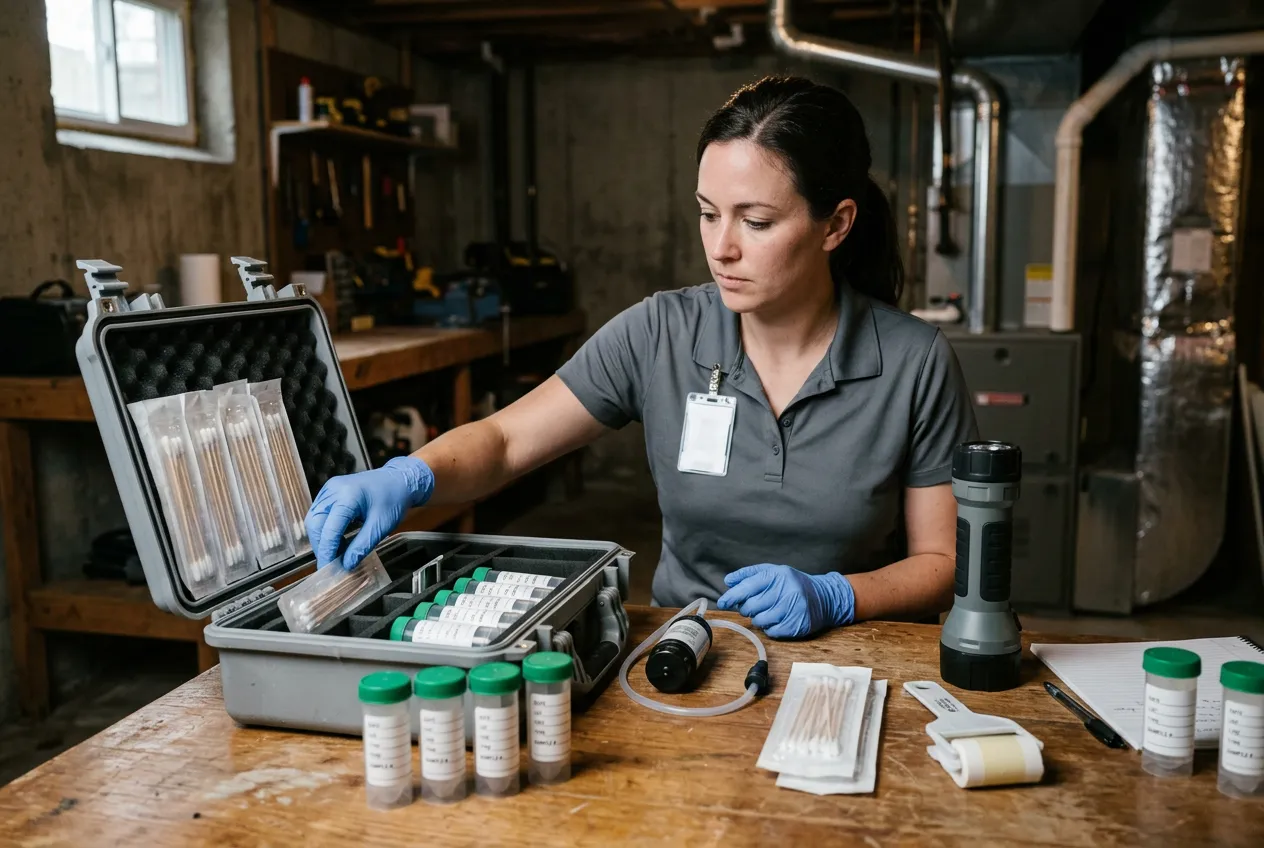
Laboratory work can still have a defined role. A consultant might propose analysis to examine an uncertain surface deposit, support a particular investigation, or evaluate a completed project under an agreed protocol. The method should follow the question.
Before approving additional charges, ask for the proposed locations, methods, and interpretation plan. Confirm whether the quoted amount includes laboratory fees, the written explanation, and a conversation about the findings. A collection fee alone may not represent the total cost of getting an answer.
Do not confuse more collection points with a better investigation. Additional locations are useful when they address a real uncertainty. They add little when no one can explain why those locations were selected or how different results would change the next step.
Air and Surface Results Answer Different Questions
A surface specimen concerns the selected spot. An air specimen concerns the particles captured during collection. Neither should be described as a complete examination of every concealed assembly in the building. NIOSH has found that a thorough visual inspection or a musty odor is more reliable than air sampling.
The professional should explain relevant conditions during the visit, including unusual activity or equipment operation. Ask how those conditions affect interpretation and whether any proposed comparisons are appropriate for the question being investigated.
| Part of the assessment | Useful purpose | Important limitation |
|---|---|---|
| Building history | Establish the sequence of events | Recollection may be incomplete |
| Photographs | Record accessible conditions | Concealed areas remain unseen |
| Instrument readings | Document conditions at selected locations | Readings need appropriate interpretation |
| Surface analysis | Examine a chosen deposit or material | Results concern that specimen |
| Air collection | Examine captured airborne particles | Conditions can vary over time |
| Written interpretation | Connect findings to next actions | Conclusions must stay within the evidence |
The most useful report combines these pieces. A laboratory page without location information or interpretation leaves the owner trying to solve a building problem from a list of unfamiliar names.
Finding Independent Help in Clark County
An independent assessor is someone whose assignment and financial relationships allow them to evaluate the condition without selling the resulting removal work. Ask directly whether the consultant performs remediation, receives referral compensation, or has a relationship with a proposed contractor.
The Clark County Health Department's healthy housing page provides a starting point, including information about indoor air quality testing companies serving Southern Indiana. A listing is a lead to investigate, not a guarantee of current availability or independence. Call candidates and confirm their present services.
A firm based in Louisville or New Albany may serve your address. Our New Albany and Floyd County testing guide covers similar questions. Ask about travel charges, scheduling, and whether the person doing the fieldwork will also explain the report. Geographic convenience matters, but the assignment still needs someone with the right experience.
If you are arranging verification after a job, choose the assessor and agree on the evaluation before work starts where practical. Waiting until the walls are closed can make it harder to check the conditions that mattered most.
Questions That Reveal More Than a Review Score
Reviews can tell you whether a business returns calls and treats customers respectfully. They rarely establish whether a particular technical conclusion was sound. Read them alongside direct questions about the proposed service.
Ask prospective providers:
- What training and experience fit this particular concern?
- Who will attend the appointment and write the conclusions?
- What areas will be examined, and what access is required?
- What is included in the fee and what costs extra?
- How will limitations and uncertainty be recorded?
- Do you sell corrective work or receive related referral payments?
- Can you provide an anonymized example of the type of report offered?
The Minnesota Department of Health's consultant-selection guidance also emphasizes matching the professional to the problem and starting with examination before deciding on analysis. Those are useful hiring principles wherever the building is located.
Avoid treating a credential logo as the whole evaluation. Confirm that a claimed credential belongs to the person doing the relevant work and ask what it qualifies them to do. Professionalism includes being clear about the limits of that role.
What to Prepare Before the Visit
Make ordinary access available without disturbing suspect surfaces. Move unrelated belongings from the approach when safe, gather previous reports, and identify the person who can authorize the appointment. Do not cut openings or pull apart finishes simply to make the visit look more complete.
Write a brief timeline. For example, note that an odor started after a dishwasher incident, disappeared during a dry period, and returned when the room was closed for several days. Observations like those are more useful than a general statement that the house has always felt wrong.
List earlier treatments accurately. Painting, spraying, replacing flooring, or running portable equipment may change what can be seen on the day. Tell the assessor what happened and when, even if the work did not solve the concern.
Follow any preparation instructions supplied by the professional. If those instructions conflict with immediate safety or necessary repairs, discuss the conflict. Do not delay stopping an active release merely to preserve an ideal testing appointment.
Read the Conclusions Before the Laboratory Appendix
A useful report should explain the finding in ordinary language. It should distinguish an observed condition from a suspected cause and identify what still needs confirmation. Look for locations, photographs, and recommendations that connect to each other.
If a conclusion seems larger than the supporting evidence, ask for clarification. One selected specimen should not become an unexplained declaration about every room. Similarly, an inconclusive result should not erase documented deterioration or repeated dampness.
Request answers to three practical questions: what needs attention now, what investigation remains, and who is suited to perform the next task? The report may appropriately recommend a plumber, building-envelope specialist, or other trade instead of a removal contract.
Keep the original report with later proposals. When contractors quote from the same documented findings, it becomes easier to compare their included work and identify differences. Otherwise, each company may be pricing a different understanding of the problem.
From Findings to Corrective Work
A recommendation for mold remediation should describe the affected areas and the intended outcome. Ask how the contributing condition will be addressed, what materials are included, and which responsibilities belong to another trade.
Separate the evaluation from reconstruction. Opening an assembly may reveal additional conditions, and any change should be documented before the price expands. New finishes should follow the necessary corrective work and readiness checks.
Our Jeffersonville service page provides a local starting point for discussing the next step. If your project requires an independent opinion, state that at the outset so the roles remain clear.
Health questions belong with a healthcare professional. A building report may help describe environmental conditions, but it does not diagnose a person or prove that a particular symptom came from the house. Keep those conversations connected without treating them as interchangeable.
Frequently Asked Questions
Do I need laboratory work when the affected area is obvious?
Often, no. The useful next step may be identifying the cause and planning the material work. Ask what additional decision analysis would support before paying for it.
Can one appointment prove that the whole house is clear?
No appointment can eliminate every limitation. Accessible areas, selected measurements, and collection conditions define what the professional can reasonably conclude. Ask that those boundaries be recorded.
Where can I start looking for an independent assessor?
The Clark County healthy housing resource is a useful starting point. Confirm each candidate's current service area, experience, financial relationships, and reporting scope before booking.
Is a general home inspection the same service?
Not necessarily. A broad condition survey may identify concerns without providing a focused environmental investigation. Read the agreement and ask which specific questions the appointment will address.
Can a report tell me whether a room is making someone ill?
A report describes building conditions within its scope. Medical evaluation is separate. Discuss symptoms with a qualified clinician rather than relying on a laboratory count as a diagnosis.
What should I ask about price?
Ask for the complete fee, including travel, fieldwork, proposed analysis, written interpretation, and follow-up discussion. Confirm how added work is authorized and what remains excluded.
Get an Answer You Can Use
The point of an assessment is to leave you with a clearer decision. You should understand what was found, what remains uncertain, and why the proposed next step fits your house. A stack of numbers is useful only when someone explains what it means in context.
Call The Mold Men at 502-660-2660 for a free inspection and quote, or schedule online. Tell us the Jeffersonville address, the concern, and whether you need a separate independent evaluation. Confirm any laboratory services and their fees before authorizing them.
Ask about our 15% double-sided referral program, up to $500. Start with the building, establish the facts, and choose the work those facts support.