
5.0 out of 5 on Google
Read our reviewsThe Mold Men Journal
Mold Testing in New Albany & Floyd County: Explained
Get a thorough mold inspection and remediation in New Albany, Indiana. Trust verified experts for mold removal to prevent health issues and certify your home.
By Chase Walkup, owner · Published
The Short Version
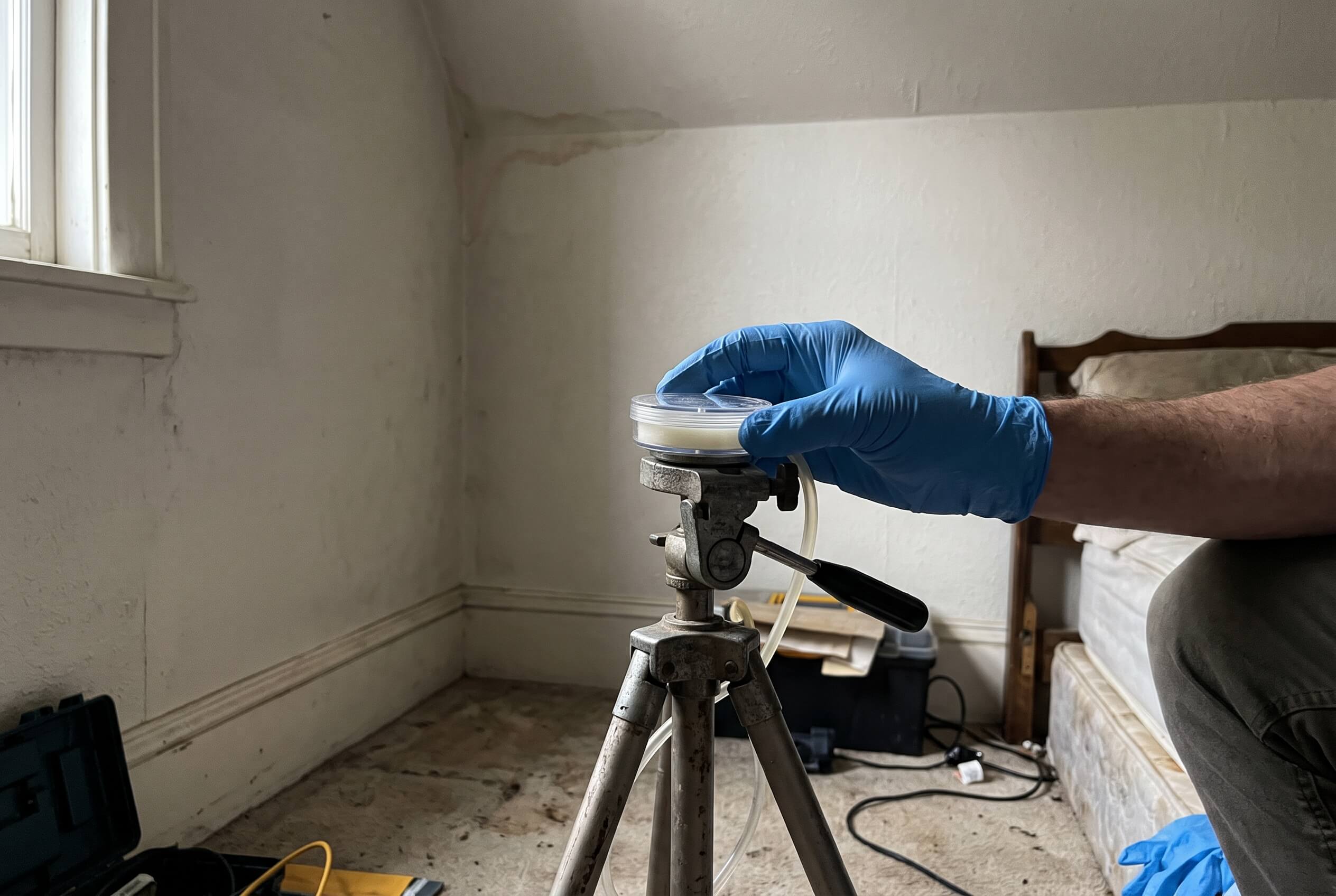
In New Albany and Floyd County, the word inspection can mean several different services. A contractor may visit to estimate removal work. A home inspector may review general property condition. An independent assessor may investigate moisture and arrange laboratory analysis. The owner should know which appointment is being booked.
The distinction matters in 47150, where a historic downtown cellar, a hillside property near Silver Hills, and a newer house farther north can have different water histories and access needs. A sampling package chosen before those details are known may leave the important question unanswered.
This guide explains the available routes, when outside assessment is worth paying for, and what a usable report should contain. It also covers how to move from findings to a repair scope without treating a lab result as a diagnosis of the whole property or its occupants.
This guide covers:
- When an outside opinion is useful
- Finding a provider serving the county
- Building history comes first
- Compare methods and limits
- What should it cost?
- Interpret findings carefully
When an outside opinion is useful
Residents of Bellemeade, Fairmont, Blackiston Heights, and Creekside in 47150 may need a separate opinion after a leak, before buying, or when a disputed repair leaves unanswered questions. The condition determines the method, rather than the neighborhood.
Useful situations include:
- An unexplained recurring odor.
- Suspected concealed damage after water entry.
- A substantial proposed removal needing outside review.
- Agreed independent verification after work.
The EPA sampling guidance explains that visible growth often does not need samples and that federal airborne limits are absent.
Finding a provider serving the county
MI&T's Louisville page includes New Albany coverage and describes test-only work. Environmental Safety Technologies describes investigation and laboratory services; confirm cross-river coverage and the site-visit scope. These are starting points for verification, not endorsements for every case.
Ask who performs the work, what relevant experience they have, and whether they sell recommended repairs or receive referral income. Confirm the lab, methods, written interpretation, travel charges, and follow-up. We cover the same questions in our Jeffersonville testing guide and our Owensboro testing guide.
Define the question before choosing the provider
A buyer approaching the end of an inspection period needs a documented assessment on a deadline. A homeowner with a recurring smell needs help finding the source. A landlord resolving a disputed condition may need an opinion independent of the company bidding the removal work.
Those needs can involve different services and deliverables. Tell the provider what decision must be made, when it must be made, and what records already exist. Ask whether the quoted appointment includes accessible-area investigation, moisture measurements, samples, and interpretation.
If the provider must travel from Louisville or another market, confirm the travel charge and return-visit arrangements. A lower advertised sampling price may not include the same site work or follow-up as another quote.
Local geography is a clue rather than a conclusion
Downtown and East Spring Street properties can contain older foundation and finish assemblies. Silver Hills addresses introduce different site and drainage questions. Northside development may involve newer materials but still have plumbing, mechanical, or ground-moisture concerns.
Describe the actual parcel and building. Has water entered after rain? Is there a sump? Has the lower level been finished? Was drainage changed? Can the assessor enter the area under the floor? That information is more useful than assuming a neighborhood name predicts the answer.
Where flood exposure is relevant, review official mapping and property records. A building being near the Ohio River does not establish that it has flooded, and a house outside a familiar riverfront area can still have another route of wetting.
A test-only service and a contractor visit have different purposes
Independence is especially useful when the findings will be used to compare bids or resolve disagreement. Ask whether the assessor sells removal work or has financial relationships with a recommended provider.
A contractor's inspection can still be useful for identifying the proposed work and cost. It should be described honestly. A free estimate is not automatically a third-party environmental report, and a verbal assessment should not be presented later as if it included laboratory analysis.
Mold Men does not currently provide independent laboratory testing. If that service is needed, arrange it separately and bring the complete report when discussing remediation.
The report should help the next contractor
A usable report identifies the affected location, the observed or suspected source, relevant measurements, and investigation limits. If samples were collected, it identifies the method, locations, and interpretation rather than leaving the owner to read the laboratory alone.
Ask how the findings become a work scope. Which materials are affected? What requires controlled access? Which source repairs belong to another trade? What conditions should be checked before rebuilding?
Without those answers, an owner can pay for an assessment and then receive three incompatible removal bids. With them, the providers can explain any differences against the same evidence.
Keep the follow-up question tied to the original concern
After repairs, review the condition that prompted the visit. A rain-related problem should be observed after rain. A concern about completed cleanup should be evaluated against agreed criteria. A new question in another part of the building may need a different assessment.
The purpose is a coherent sequence from the original concern to a documented decision, not an endless collection of numbers with no clear next step.
Building history comes first
A smell after rainfall points toward different pathways from a one-time appliance failure. Measurements should support accessible observations, with inaccessible areas documented.
Bring:
- Leak dates and photographs.
- Prior repairs and invoices.
- Areas where staining returned.
- Previous reports and collection locations.
- Changes to cooling or ventilation.
A thermal image can guide investigation but does not directly prove growth or hidden water.
Compare methods and limits
| Method | Useful information | Limit |
|---|---|---|
| Visual assessment | Accessible material condition | Closed cavities remain uncertain |
| Material reading | Current wetting | Does not identify species |
| Air collection | Particles during the visit | Not a permanent safety certificate |
| Surface sample | One selected location | Not the entire residence |
| Completion review | Agreed conditions after work | Cannot prevent future leaks |
A report should connect these findings. Laboratory pages without interpretation are not a complete investigation.
What should it cost?
There is no verified fixed local fee suitable for every Indiana property. Access, size, sample count, urgency, and report detail affect the price. Compare written itemized quotes for equivalent work.
Separate the visit, laboratory charges, recommendations, travel, and return review. Ask what happens if sampling is not justified. Extra samples should have a purpose, rather than simply fill a package allowance.
Interpret findings carefully
Environmental results cannot establish which exposure caused a medical condition. NIOSH notes that there are no health-based standards for mold in indoor air. A residence also does not need to be sterile. Health questions require healthcare evaluation.
For significant cleanup, agree on completion before starting: source correction, suitable drying, clean retained materials, and outside review where appropriate. Further samples should answer an agreed question.
Buy an answer rather than a stack of laboratory pages
Before purchasing samples, finish this sentence: the result will help us decide whether to do what? If nobody can answer it, the collection plan is not ready. A concealed-source investigation, a disagreement about completed work, and a routine real estate inspection can all involve samples, but they do not call for the same locations or interpretation.
The laboratory analyzes what it receives. It does not see the damp cabinet, the disconnected bath fan, the open window, or the furniture moved just before the appointment. That information must come from the person conducting the investigation. A report can have precise numbers and still be weak building advice if the collection conditions are missing.
Ask the provider to separate these parts of the service:
- The building interview and visual assessment.
- Moisture measurements and accessible-area investigation.
- The collection method and proposed locations.
- Laboratory analysis and any expedited charge.
- Written interpretation and recommendations.
- Follow-up questions or a return visit, if included.
This makes quotes easier to compare. Two companies can offer the same number of samples while providing very different amounts of investigation. One might include entry into accessible spaces under the house. Another might collect only from the rooms you named on the phone. Neither scope should be assumed from the word inspection.
What to ask when the report arrives
Start with the conclusion, then look at how the evidence supports it. Where were the samples taken? What method was used? Was an outdoor comparison appropriate to the investigation, and what were conditions at collection? Were suspect materials actually observed? What could not be inspected?
A useful interpretation distinguishes the sampled location from the entire property. A surface result addresses the material selected. A short air collection describes particles captured during that collection period. Neither one inventories every wall cavity. A low result may be reassuring within its scope without ruling out concealed damage elsewhere.
If a report recommends removal, ask how the findings define the work. Which room, which assembly, and which materials? If it recommends more investigation, ask what the next investigation should resolve. A lab sheet with no practical interpretation leaves the owner paying someone else to decide what the first service meant.
Keep the complete report, including laboratory pages, location notes, and limitations. When seeking another opinion, send all of it. A screenshot of the highest number can lose the context that makes the result understandable.
Independence is a relationship you can check
Ask whether the assessor sells cleanup, refers it for a fee, owns a related repair business, or regularly verifies the same contractor's work. Those arrangements do not automatically prove misconduct. They do affect how independent the opinion is, which matters more in a dispute than during a straightforward repair estimate.
Mold Men does not currently provide independent laboratory testing. Our free inspection helps identify the building work and proposed scope. When a separate assessment is needed, arrange it with an appropriate provider and decide before cleanup who will evaluate completion. That keeps the laboratory question, the removal contract, and the final review from being confused with one another.
What a useful site visit should leave you with
A visit should make the next decision easier. Before anyone starts, give the person inspecting the property the history in the order it happened. A dishwasher leak followed by a new floor, followed by a smell when the heat comes on, is a different story from a basement that smells only after a week of rain. Dates do not need to be perfect. The sequence does.
Point out what has already been changed. New paint, replacement baseboards, a removed cabinet, and a dehumidifier moved into the room can hide or alter evidence. That is not a reason to leave a leak running. It is a reason to photograph the condition and explain the changes instead of expecting the inspector to reconstruct them from a finished wall.
The walkthrough should connect the affected room with the rest of the building. Water on a basement floor may start at a downspout outside. A stained ceiling may connect to a roof penetration, a bathroom above it, or condensation in an attic. An instrument reading matters more when the person taking it can explain that connection.
Ask for the findings in a form you can use:
- Photographs labeled by room and location.
- The observed water source, or the next investigation needed to establish it.
- Material readings with enough detail to identify where they were taken.
- Areas that could not be inspected and why access was limited.
- A distinction between confirmed damage and a reasonable suspicion.
- The proposed next step, including work assigned to another trade.
A thermal image can help identify a temperature pattern worth investigating. It does not, by itself, identify fungal growth or prove that a surface contains moisture. Likewise, a scanning meter can flag an area for closer examination without giving a complete account of every layer behind it. Good instruments make an investigation better when their limits are understood.
There is also a practical question about access. A hatch blocked by furniture, a crawl space with standing water, or a wall covered by built-in cabinets may prevent a complete assessment. Ask what can be concluded now and what requires another visit or controlled opening. An honest limitation belongs in the report, not in a conversation you cannot later document.
Keep the repair in a sensible order
The source repair and the cleanup may involve different people. A plumber can stop a supply leak without deciding whether wet insulation should remain. A roofing contractor can repair flashing without evaluating the back of the ceiling below it. Make the handoff explicit so each trade knows what has been completed and what remains.
Before new finishes cover the work, confirm that the source correction is complete, retained materials meet the agreed drying criteria, and the cleanup checks have been performed. Keep photographs of the exposed assembly. They are useful if you sell the property, make an insurance claim, or investigate a later leak in the same area.
Finally, put a follow-up on the calendar. Check after the next relevant weather event or period of normal use. A repaired shower should be observed after it is used again. A drainage correction should be reviewed after rain. The purpose is to see whether the building behaves differently, rather than simply whether the new paint looks good.
Frequently Asked Questions
Is a free contractor visit independent sampling?
No. It can help price the work, but its commercial role should be clear.
Does a public provider list guarantee quality?
No. Verify current qualifications, coverage, and scope directly.
Should a buyer sample every room?
Not automatically. Define the concern and choose an appropriate method.
Can a report certify future safety?
No. New leaks and building changes can alter conditions.
Is radon included in the same collection?
No. It is a separate gas hazard requiring its own measurement method.
Turn the findings into a repair plan
If your New Albany or Floyd County property has affected materials, bring the water history and any independent report. We can discuss the removal scope and the responsibilities for correcting the source. For independent laboratory testing, arrange an appropriate separate provider.
Book a visit through our online scheduler or call 502-660-2660 to talk through the property. Inspections and quotes are free. Review our New Albany and Mold Remediation pages for more about the relevant services.
Mold Men is based in Louisville and serves the Louisville metro, Owensboro, New Albany, and Jeffersonville. We also handle crawl space encapsulation and vapor barrier replacement when moisture under the floor is part of the problem, along with hoard cleanouts and junk removal when access needs to be restored first.
Every job comes with a written scope before work starts and a written closeout report when it is done. Our referral program pays 15 percent, up to $500, when someone you refer books qualifying work. If you are unsure which service fits, explain the condition when you call and we can discuss the appropriate next step.