5.0 out of 5 on Google
Read our reviewsThe Mold Men Journal
Mold in Historic New Albany Mansion Row & East Spring Street
Protect your historic New Albany home from mold. Learn how to preserve Mansion Row & East Spring Street properties in these historic districts.
By Chase Walkup, owner · Published
The Short Version
New Albany sits on a river terrace at the Falls of the Ohio, with the Knobs behind it and Silver Creek along its western edge. If you need testing first, see our New Albany and Floyd County testing guide. The oldest part of town went up between the 1830s and the 1890s, when steamboat money paid for large brick houses with lime mortar walls, plaster interiors, deep cellars, and nothing anyone today would call a moisture barrier. They are still standing, and still taking on water.
Most of the mold we find in 47150 is not a mystery. It traces back to repeating failures: downspouts discharging at the wall, grade that has crept up over 150 years, soft brick wicking moisture into sill plates, unvented dirt substructures, bathrooms retrofitted with no exhaust, and central air added to a house never designed for a cold surface in a humid space. Stop the water and the mold stops. Do it in a way that keeps the plaster, the original woodwork, and the historic character of the place, and you keep the value too. Our guide to mold in Old Louisville's historic homes covers the same issues across the river.
It is written for anyone with a property in the East Spring Street Historic District, the streets off Ekin Avenue, the commercial core, Silver Hills, or the rest of New Albany and Floyd County's 1800s housing.
- Why this housing stock and this river valley work against you
- What fails where, and the water paths behind nearly every case
- Which mold genera turn up in old plaster, and what each signals
- Remediating without destroying original material
- Containment, HEPA filtration, and drying without damage
- What to save, what to sacrifice, and which standards apply
- Commission approval and what gets reviewed
- Encapsulation, vapor barriers, and seasonal patterns
- Costs, disclosure, claims, and selling into this market
Why 1800s Construction in This River Valley Stays Damp
Mold needs food, a workable temperature, and water. In a house framed with old growth lumber and finished in lime plaster over wood lath, the first two are permanent. Water is the only variable anyone controls, and three things make the older core of town harder than a 1990s subdivision on the north side.
- Ohio valley humidity. From May into September, dew points here sit in the upper 60s and low 70s for weeks, so any surface cooler than the surrounding air collects condensation. A cellar wall at 62 degrees in air at a 71 degree dew point is permanently wet.
- Vapor permeable masonry. Soft fired brick and lime mortar are meant to breathe, part of why these houses lasted. It also means a foundation in wet soil moves water inward.
- Ground vapor. Bare soil under a house releases vapor upward all year, and in silt loam over river gravel it never fully dries.
Then add 150 years of remodels. Central air, storm windows, caulk, and blown insulation each made sense in isolation, and together they slowed the drying that kept the structure healthy. Homeowners are often surprised that the most recently updated rooms are the ones with growth behind the trim.
Relative humidity is the number to watch. Hold the interior between roughly 30 and 50 percent and mold mostly cannot start. Above 60 percent for weeks, growth becomes likely on any organic surface. A cheap hygrometer in the lowest level tells you more than almost anything else you can buy.
What Fails Where in New Albany's Historic Districts
These areas share one ZIP code, 47150, but the housing stock is not the same and neither are the failures. Here is what the crews we send out see most often.
| Area | Typical construction | Common failure | Difficulty |
|---|---|---|---|
| The East Main corridor | 1850s to 1890s masonry, three stories, deep cellars, ornate interiors | Cellar seepage, sill plate rot, plaster damage on outside walls | High, original material everywhere |
| East Spring Street Historic District | Brick and frame, Italianate and Queen Anne style, some cut into apartments | Roof valley and gutter leaks, bath retrofits without exhaust, attic condensation | Moderate to high |
| Cedar Bough Place Historic District | Early 1900s upper-class residences on a short, quiet street under mature oak canopy | Shaded roofs staying wet, gutters packed with leaf litter, damp substructures | Moderate |
| Market Street and Pearl, downtown New Albany | Commercial blocks with apartments above, flat roofs, open basements | Interior roof drains, storefront intrusion, humid basement air rising | High |
| Silver Hills and the west slope | Frame houses from the 1800s on, developed as a wooded retreat above town | Hillside water at the uphill wall, poor site drainage, seeps and springs | High |
| Midtown, Crandon Park, Bellemeade, Fairmont, Audubon Place | 1920s to 1960s frame and brick veneer | Torn ground barriers, condensation on ductwork, negative grading | Low to moderate |
Elevation matters more than location. Two houses one block apart behave differently because one sits a few feet higher, and near the floodwall a spring rise on the Ohio shows up as damp masonry well inland. Several of the grandest places along the row were long ago adapted into offices, apartments, and a funeral home, and commercial HVAC gives that shell a different humidity profile.
Foundations: Cellar, Rubble Stone, or Dirt Space
Under the older houses in this part of Indiana you find one of four situations, and the fix changes with each.
| What is underneath | Where it shows up | How it fails | What the repair involves |
|---|---|---|---|
| Full cellar, soft brick or rubble stone walls, earth floor | Main Street, East Spring Street, the core | Wicking through mortar joints, hydrostatic seepage, saturated summer air | Outside water management, then interior drainage, then dehumidification |
| Partial cellar joined to a dirt space, or a shallow vented substructure | Rear ells, later additions, Midtown | Ground vapor, summer condensation on cold framing, torn plastic | Barrier replacement or encapsulation, close the vents, add drying capacity |
| Slab on grade addition against an older wall | Post 1970 kitchen and family additions | Slab edge wicking, wet flooring, water trapped where new meets old | Correct grading and downspouts, remove affected finishes, dry and seal |
The detail that matters most in 19th century masonry is the sill plate, the timber carrying the framing where it bears on the foundation. Sitting on damp brick with no capillary break, it stays wet and rots from the bottom. Mold on the joist ends is the symptom, the rot is the problem, and that is a structural repair rather than a cleaning job. A crew that scrubs the joists without addressing why the sill is wet has sold you nothing.
The Water Paths Behind Nearly Every Case
Over and over, in this town, it comes down to the same short list.
- Roof and gutter. Box gutters, slate, and standing seam roofs need maintenance most people are not doing. One failed valley, or a downspout dumping six inches from the wall, soaks a foundation for years.
- Grade. After 150 years of fill, mulch, and sidewalk replacement, soil often sits above the interior floor level. Regrading so water runs away is the cheapest high value fix on this list. The University of Minnesota Extension recommends a slope of at least 1 inch per foot for 6 feet away from the wall.
- Plumbing. Cast iron drains and galvanized supply lines reach end of life around the same time, and a slow leak inside a plaster wall can run a year before anything shows.
- Bathrooms and laundry areas. Retrofitted with no exhaust, or with a fan dumping into the attic. In a house with no vapor control, that moisture lands in the framing.
- HVAC. Clogged condensate lines, air handlers in a humid basement, uninsulated duct in unconditioned space. Cold ductwork in a hot attic sweats onto the ceiling below.
- Site water. On the slopes above town, runoff and shallow springs push at the foundation. Downspout extensions, a French drain, or a swale solve more than any interior product.
A lower level depending on one sump pump with no backup is a known point of failure, and we see the results every spring.
Which Molds Turn Up in Old Plaster and Framing
Identification by eye is not reliable, and color tells you little. Here is what we typically find, and what it says about the water source.
| Genus | Where it commonly shows up | What its presence usually indicates |
|---|---|---|
| Cladosporium | Window sashes, cool outside walls, plaster behind furniture | Condensation and high indoor humidity, not necessarily a leak |
| Penicillium and Aspergillus | Cellar contents, stored paper, carpet pad, wall cavities | Chronic dampness, often ongoing for months |
| Stachybotrys | Paper faced drywall, wet cellulose, saturated wood | Prolonged saturation, usually a leak that stayed wet a week or more |
| Chaetomium | Wet drywall paper, damp wood, water damaged plaster | Similar, and common after roof and plumbing failures |
| Alternaria | Bathrooms, around sinks and tubs, damp window trim | Repeated wetting from daily use rather than a structural leak |
| Ulocladium, Fusarium, Trichoderma, Mucor | Flood affected material, sewage events, saturated substructures | Category 2 or Category 3 water intrusion |
A note on health. Reactions vary widely from one person to the next, and visible growth affects an allergic or immunocompromised occupant differently than a healthy adult. We are not physicians and we do not diagnose. Symptoms someone connects to the house belong with a doctor.
EPA guidance is straightforward on scale: patches of roughly ten square feet or less on a hard surface are often a reasonable do it yourself job. Anything larger, or anything inside a wall assembly, in ductwork, or connected to sewage, needs containment and equipment most households do not have.
How Do You Remediate a Historic Home Without Wrecking It?
This is the question we get asked most in this neighborhood, and the honest answer has two parts.
First, the goal is not sterility. No standard requires it and no house achieves it. The goal of proper mold removal is to remove the growth and the affected porous material, clean what remains, dry the assembly back to normal readings, and eliminate the water source. For historic buildings, the National Park Service's Preservation Brief 39 adds a key rule: "Avoid remedial treatments without prior careful diagnosis."
Second, old construction gives you an advantage new construction does not. Modern gypsum drywall is wet paper on a stick, and once colonized it comes out. Plaster is inorganic and unfriendly to growth, so once the water source is corrected and the assembly dries, sound plaster can very often be cleaned and kept. The lath behind it is the vulnerable layer, and how far the water traveled decides whether the wall stays.
What that looks like on site:
- We open the smallest area that verifies extent, working from a moisture meter map rather than a guess, and cut back to sound dry material instead of removing a full wall by default.
- Original trim, casing, mantels, and stair parts come off carefully, get tagged, cleaned, and go back. Architectural woodwork is almost always salvageable because it is dense, finished, and not paper faced.
- Abrasive cleaning stays off original surfaces, and never touches a finish worth keeping.
- Antimicrobial products, when used at all, go on after physical removal. A dead spore on a wet substrate is still an allergen.
If a contractor's plan for an 1880s parlor is to gut it to the studs, ask which moisture readings justify that. Sometimes the answer is legitimate. Often it is just faster.
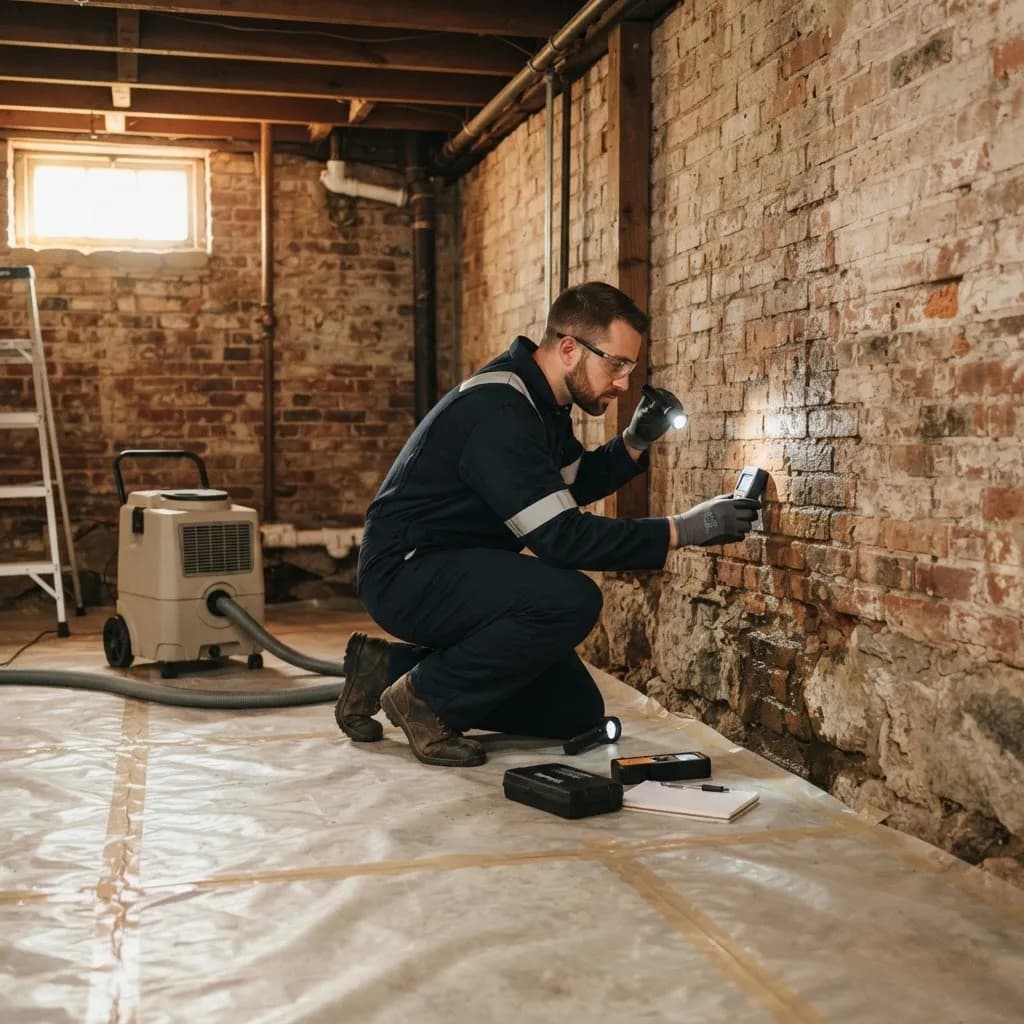
The equipment side is standard work with one adjustment for age. Polyethylene containment with a zippered entry keeps spores out of clean space, and it has to seal at the floor line as well as the doorway, because open stair halls and balloon framed cavities carry air the full height of the house. A negative air machine holds the work area below the pressure of the rest of the house, air scrubbers with true HEPA media run during and after, and HEPA vacuuming handles the final pass. Drying is psychrometrics, not fans: temperature, humidity, and airflow managed together, readings logged daily. Old timber and thick plaster give up water slowly, and pushing heat too hard on old finishes causes cupping.
Save It or Lose It
| Material | Usual verdict | Why |
|---|---|---|
| Lime plaster over wood lath | Usually savable if the assembly dries and the lath is sound | Plaster is inorganic and growth is typically surface level |
| Original trim, doors, mantels, stair parts | Almost always savable | Dense, finished, not paper faced, cleans well |
| Paper faced gypsum drywall | Remove | The paper facing cannot be reliably cleaned once colonized |
| Framing, joists, and sill plates | Usually savable, sometimes needs sistering | Surface growth cleans, but rot means lost section and partial replacement |
| Carpet, pad, batt insulation, cellulose, particleboard | Remove | Porous, holds water and spores, no reliable cleaning |
| Masonry, stone, brick | Savable | Clean and dry, then treat the water source rather than the wall |
Where the Rules Come From
There is no single national mold law. Knowing who publishes what keeps you from being oversold.
- EPA publishes homeowner guidance on mold cleanup and indoor air quality. It is guidance, widely respected, and not enforceable code.
- IICRC S520 is the ANSI approved consensus standard of care for mold remediation, defining Condition 1, 2, and 3 environments, containment, worker protection, and the principle that source removal comes before chemical treatment.
- IICRC S500 is the companion water damage standard, classifying water by Category for contamination and by Class for drying load. Most mold jobs began as a water job handled late.
- OSHA governs worker safety, ASHRAE publishes ventilation standards that shape how a structure handles humidity, CDC provides public health information on exposure, and HUD guidance shows up in assisted housing and rehabilitation work.
Indiana does not license mold remediation contractors the way a handful of states do, which puts the burden on you to vet the company. Credentials worth asking about include IICRC certifications such as AMRT for applied microbial remediation and WRT for water restoration, along with CMR type designations from other bodies. These are individual technician credentials, not company licenses, and a firm should tell you which people on your job hold which.
Commission Approval and Work You Can See From the Street
Two separate systems apply here, and they get mixed up constantly.
National Register of Historic Places listing is administered through the Indiana state office under a federal program. For a private owner, listing on the National Register of Historic Places is largely honorific. It recognizes significance and opens the door to certain tax credits for qualifying rehabilitation, and it does not by itself restrict what you do with your house using your own money.
Local designation is the one with teeth. The New Albany Historic Preservation Commission reviews exterior work in locally-designated areas through a certificate of appropriateness, covering what the public can see: windows, siding, masonry, roofing, porches, and additions.
What that means for mold work:
- Interior remediation, cleaning plaster, replacing a rotted sill from inside, running equipment, generally falls outside design approval.
- Outside work usually does not. Repointing, replacing windows, altering a porch, adding a foundation vent, and regrading the visible site can all require it.
- Repointing deserves attention. Portland cement mortar on soft old brick traps moisture and spalls the brick face, so it is done with a lime based mortar matched to the original in strength, texture, and color. That is both a preservation requirement and a moisture requirement.
- Ask early. A conversation before you schedule the project beats a stop order in the middle of it.
Locate the district inventory and nomination documents, which describe the contributing buildings and why each counts. Knowing what makes your house significant tells you what not to remove.
Encapsulation and Vapor Barriers Under an 1890 Foundation
Where there is a dirt substructure or an earth floored cellar, ground vapor is usually the largest moisture load in the house. The fix is well established.
- Clear debris, old torn plastic, and organic material off the ground.
- Handle bulk water first: grading, downspout extensions, a perimeter drain and sump where the water table demands it.
- Lay a reinforced vapor barrier across the soil, lapped at the seams, run up the walls, fastened and sealed. The Department of Energy's sealed crawl space guidance describes the same approach.
- Close the perimeter vents. Venting a substructure to humid outside air in July adds moisture, it does not remove it. That is settled building science, though it contradicts what people were told for decades.
- Add a dehumidifier sized for the volume, draining to a condensate pump or to daylight, with a hygrometer so the number is visible. In a masonry cellar, consider a capillary break at the sill during any framing repair.
Full encapsulation is not right everywhere. Under an 1886 house with an earth floored cellar, the work has to be planned so the masonry can still dry, usually inward.
Season by Season in the Ohio Valley
| Season | What drives moisture | Where it shows | What to do |
|---|---|---|---|
| Late winter and early spring | River rise, saturated ground, snowmelt, storm sewer backup | Cellar seepage, standing water underneath, long sump run times | Test the sump and its backup, clear gutters before the spring rain |
| Late spring and summer | High dew points, condensation on cold surfaces, AC condensate | Sweating ductwork, musty lower level, growth on stored contents | Run a dehumidifier, hold humidity under 50 percent, clear condensate lines |
| Fall | Leaf litter under mature canopy, clogged gutters and valleys | Overflow at the wall, wet roof decking, attic dampness | Clean gutters twice, check valleys, verify downspout discharge |
| Winter | Indoor humidity meeting cold surfaces, ice damming on complex rooflines | Window condensation, attic frost, wall cavity moisture | Ventilate the attic properly, exhaust bath and kitchen fans outdoors |
Cost and Timeline Ranges, Plainly Labeled
These are typical ranges in this market. They are not quotes, and they vary by region, access, scope, and how much original material needs careful handling. Anyone giving a firm number without seeing the house is guessing.
| Scope | Typical range | Typical duration | Notes |
|---|---|---|---|
| Single bathroom or laundry area, contained | Low hundreds to about 1,500 dollars | Half a day to two days | Usually includes correcting the exhaust |
| One room, plaster affected, containment and drying | Roughly 1,500 to 5,000 dollars | Two to five days | Careful trim removal adds time |
| Full cellar with contents and drying | Roughly 3,000 to 12,000 dollars | Three days to two weeks | Contents handling is the big variable |
| Substructure barrier replacement or encapsulation | Roughly 3,000 to 15,000 dollars | Two to five days | Depends on square footage and access |
| Whole house affected, Category 3 water | 15,000 dollars and up | Two weeks or more | Structural repairs priced separately |
| Third party clearance testing | Roughly 300 to 800 dollars | One day plus lab time | Paid to an independent party, not the remediator |
Access drives cost more than people expect. A tight cellar hatch, a narrow stair, and curbside only parking all add hours.
Planning to Sell? Disclosure, Claims, and the Market
Sellers ask whether a remediation history hurts them. Documented, it is the opposite. Indiana requires a residential real estate sales disclosure form, and known moisture and mold issues belong on it. A buyer's inspector will find the evidence anyway, because old staining, patched plaster, and a fresh vapor barrier are visible.
- Documented and repaired reads as maintenance. A file with the scope of work, moisture logs, photos, third party clearance results, and a warranty tells a buyer the problem is closed.
- Undocumented and painted over reads as a hidden defect. That is what kills deals and drives late price reductions.
- Put it in writing. Verbal assurances are worth nothing to either side in a dispute.
On insurance, most policies pay for sudden and accidental water events while excluding long term seepage, ground water, and deferred maintenance, with mold coverage frequently capped by endorsement. Read the policy language rather than assuming, and photograph everything before work begins.
For buyers, a moisture focused inspection before closing is money well spent. This market rewards intact original detail.
What a Good Contractor Puts in Writing
Call a professional when the affected area is larger than a small patch, when it sits inside an assembly or the HVAC system, when the water was Category 2 or Category 3, when there is rot or sagging, or when the material at risk is original to a house you mean to protect. Before signing anything, ask for the list below. A company that will not provide it is telling you something.
- A written scope with affected areas measured, not described vaguely.
- The water source and how it gets corrected, or a statement of who should handle it.
- The containment and equipment plan: barriers, negative air, HEPA filtration, drying targets.
- Which materials come out and which stay, itemized.
- Daily moisture readings provided to you, not kept internally.
- A position on third party clearance testing, and who pays for it.
- Proof of liability cover, and the technician credentials assigned to your job.
- Warranty terms in writing, with what voids them stated plainly.
We recommend independent verification rather than grading our work ourselves.
Frequently Asked Questions
Does mold mean my 1880s house is failing structurally?
Not by itself. Surface growth on framing is a moisture indicator. What matters is whether the wood has lost section to rot, particularly at sill plates and joist ends bearing on damp masonry. That gets probed and measured, and it is a repair separate from remediation.
Can original plaster be saved, or does it all come out?
Sound lime plaster over wood lath can very often be cleaned and kept once the assembly dries. The decision turns on how far the water traveled, whether the lath is compromised, and whether the plaster has lost its key to it.
Do I need commission approval for mold work?
Interior remediation generally does not. Outside work does in a designated district: repointing, windows, porches, roofing, added vents, and site changes visible from the street. Ask before you schedule, not after.
Should I test for mold before remediation?
If you can see it and know where the water is, testing often adds cost without changing the plan. It earns its keep when growth is suspected but not visible, when occupants are reacting, when you need documentation for a claim, and for clearance afterward.
Who should do the clearance testing?
Someone independent of the company that did the remediation. Sampling interpreted by the same firm that performed the work is a conflict of interest, however honest that firm may be.
Will encapsulation fix a wet cellar with masonry walls?
It helps with ground vapor, often the largest load, but it does not stop bulk water. Grading, gutters, and drainage come first. In masonry the plan also has to leave the wall a way to dry, or you relocate the problem.
How long does the work take in a large multi story house?
Small contained jobs run a day or two. A room with plaster involvement runs several days. A full cellar, or a Category 3 event, runs one to three weeks. Old dense assemblies cannot be dried in a hurry.
Is black mold more dangerous than the rest?
Color is not a reliable indicator. Stachybotrys usually means a material stayed saturated a long time, but several genera look dark and several harmful ones do not. Health questions belong with a physician.
Get an Inspection Before the Next Wet Season
If your 1800s house has a musty lower level, a stain on the parlor ceiling, or a crawl space nobody has looked at in a decade, get eyes on it before spring. Inspections and quotes are free, and finding a wet sill plate this year is a far smaller job than replacing it in three.
Book directly with our online scheduler.
Or call 502-660-2660 and talk to someone who has worked in houses like yours.
We serve the Louisville metro, New Albany, Jeffersonville, and Owensboro. Beyond remediation we handle crawl space encapsulation and vapor barrier replacement, plus hoard cleanups and junk removal when a place has to be cleared before anyone can assess it. If you have had work done elsewhere and want an independent review of whether it held, we will tell you straight.
We also run a referral program paying 15 percent, up to 500 dollars, when you send a neighbor our way. On a walkable street where every house shares the same soil and the same 150 years of weather, that comes up often.